Vision
In our technologically driven world, digital systems have increased efficiency and made information more widely accessible. However, they often create a disconnect between our actions and their consequences [6]. Essentially, a big part of our perception of our actions takes place in a physical way combining multiple senses. A lot of this understanding disappears when actions become digital: digitalization puts us at risk of losing meaningful interaction with the world around us.
Take the digitalization of money as an example. The physicality of cash money provided an immediate awareness of value exchange and quantity. The shift to cashless payments has reduced our perception of money to a number on a screen, desensitizing us to how much we spend. This loss of connection with our purchases creates a “cashless effect”: individuals tend to spend more when money is intangible [4].
Problems such as the cashless effect are increasingly addressed through tangible design approaches that aim to rematerialize design within digital systems as seen in the examples in figure 1 and 2 [1]. I believe that by engaging users in physical interaction, design enables learning through doing [5] to allow digital actions to become less abstract, creating more understandable and situated interactions.

Figure 1 - New Deal Design's Scrip device as a replacement for cash [2]

Figure 2- Prototype of an interactive alternative for payment terminals [1]
Designing such interactions requires a nuanced understanding of the context in which interaction takes place. This context extends beyond the user such as stakeholders, cultural and economic influences, and technological infrastructures. Music is a context where tangible actions provide the means for creative expression. As a musician, I experience how playing an instrument is a form of learning, creating, and communicating through doing and highlights the importance of tangibility.
Learning how to accurately translate creative expression from the brain into your instrument is highly complex, especially within improvisation where this translation happens instantly [3]. The tangible and embodied nature of playing music and the emergence of technologies such as AI and MIDI create opportunities to develop alternative learning methods, explore data, and expand creative expression. By employing user- and context-centered design methods, I act as an intermediary between the tangible human experience where the interaction happens and technological systems that facilitate new possibilities.
In my design practice I use the latest technologies to provide support and deepen the connection between the user and their practice to be able to experience and understand what you hear, knowing what you want to express and apply it using an instrument. To do this, a deep understanding of the context is essential for creating situated design that grounds real-world interaction and support users in their actions. I combine technological possibilities with tangible interaction to make abstract processes perceptible, facilitate learning and establish a legible relation between action and consequence.
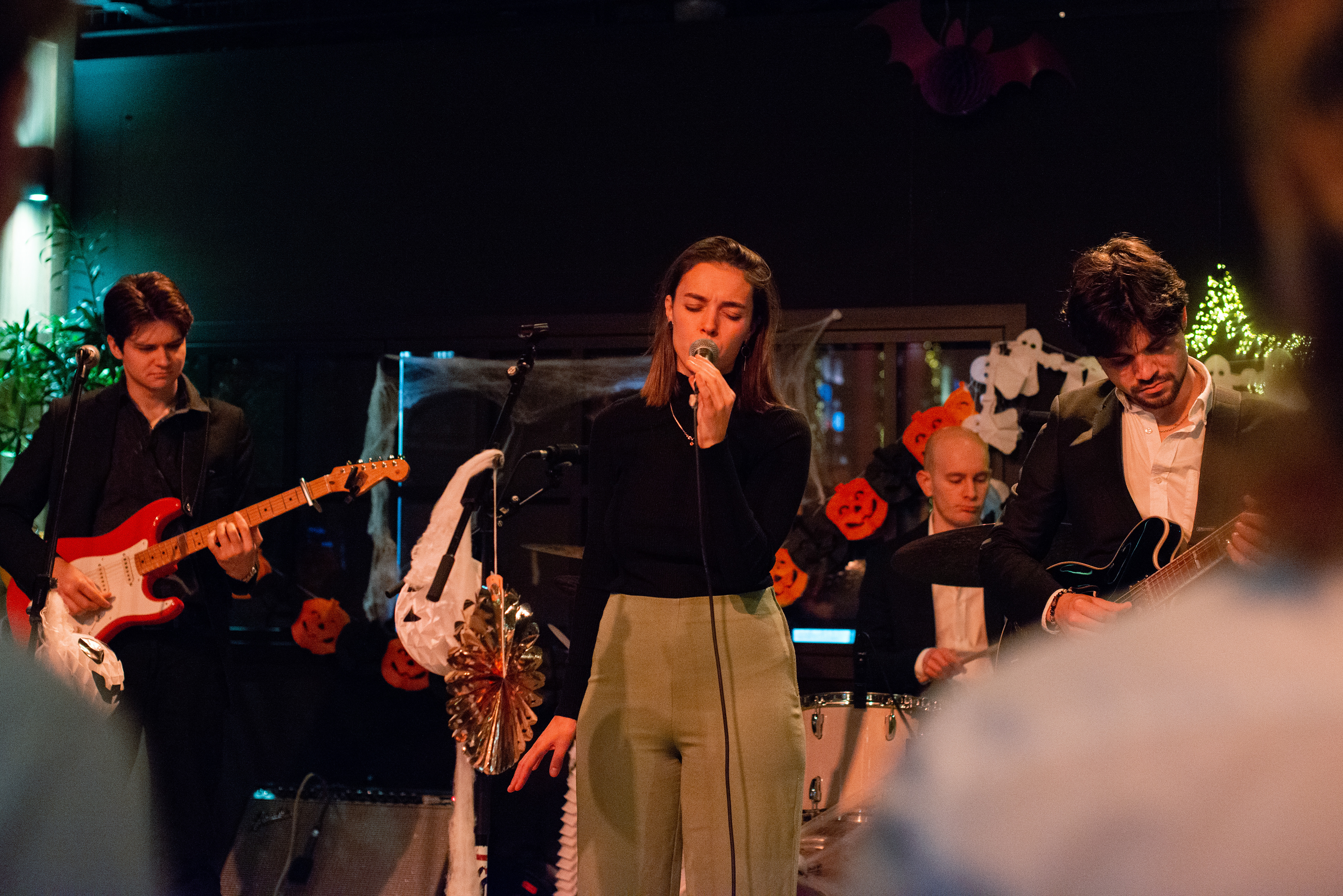
Picture by Sem Jordaan
Professional Identity
I am an interaction designer who is highly involved with users and its stakeholders. Understanding a context allows me to become sensitive to an environment and to empathize with a user's needs. This involvement is the starting point for my work.
I see myself as an intermediary between the abstract and the practical, and I find it important that my designs are accessible and transparent. Users should be able to follow how a system translates the abstract into the physical, and learn from it.
This is why I value physical and interactive products. They are a way to make sense of the abstract, and multi-modality helps understand it in different ways. My work positions itself in music education, with a focus on facilitating creative expression and learning through doing using physical interaction design. Here I use technology to support creativity.
The Reflective Transformative Design Process (RTDP) helps me maintain an overview throughout a design process. Its open-ended nature has given me personal insight into how to steer the process in a way that suits me, and how to construct a future context. To do the latter, I extrapolate current trends in music education and combine these with developments in tangible interaction and context-centered design.
I have developed a sensitivity to multiple perspectives by prompting the different people involved and interpreting their feedback. My background as a musician supports me within the music-education context as I can engage with users and their needs with first-hand understanding. I am skilled in rapid physical prototyping, creating fully functional and experiential prototypes to be evaluated by the user in their context, which has made me a well-rounded designer with a broad range of prototyping skills. I have extensive experience with 3D-printing and laser cutting for form giving, and I am comfortable working with electronics and software, specifically within system design.
Within a team, I often position myself as a facilitator and organizer. I bring a bird's-eye view to the project, as I am adept at finding connections and overseeing the process as a whole. This allows me to look ahead and to recognize when and how to intervene. A pitfall of this role is that I can become preoccupied with the organizational side, leaving me less time to attend to my own specialization. Because I feel responsible for the entire project, I sometimes find it hard to identify where my responsibility ends and someone else's begins.
References
[1] Campenhout, van, L. D. E., Frens, J. W., Overbeeke, C. J., Standaert, A., & Peremans, H. (2013). Physical interaction in a dematerialized world. International Journal of Design, 7(1), 1-18.
[2] Dan Howarth. (2016). New Deal Design's Scrip device brings tactility to digital payments. Dezeen. https://www.dezeen.com/2016/09/22/new-deal-design-gadi-amit-scrip-device-tactility-digital-payments/
[3] Jamey Aebersold (1992). How To Play Jazz and Improvise. (6th ed.) Jamey Aebersold, New Albany, IN, U.S.A
[4] Pilat, D., & Krastev, S. (2021). Cashless Effect. The Decision Lab. Retrieved March 17,2026, from https://thedecisionlab.com/biases/cashless-effect
[5] Scott R. Klemmer, Björn Hartmann, and Leila Takayama. 2006. How bodies matter: five themes for interaction design. In Proceedings of the 6th conference on Designing Interactive systems (DIS '06). Association for Computing Machinery, New York, NY, USA, 140–149. https:// doi.org/10.1145/1142405.1142429
[6] United Nations. (2026). The Impact of Digital Technologies. United Nations. https://www.un.org/en/un75/impact-digital-technologies
[2] Dan Howarth. (2016). New Deal Design's Scrip device brings tactility to digital payments. Dezeen. https://www.dezeen.com/2016/09/22/new-deal-design-gadi-amit-scrip-device-tactility-digital-payments/
[3] Jamey Aebersold (1992). How To Play Jazz and Improvise. (6th ed.) Jamey Aebersold, New Albany, IN, U.S.A
[4] Pilat, D., & Krastev, S. (2021). Cashless Effect. The Decision Lab. Retrieved March 17,2026, from https://thedecisionlab.com/biases/cashless-effect
[5] Scott R. Klemmer, Björn Hartmann, and Leila Takayama. 2006. How bodies matter: five themes for interaction design. In Proceedings of the 6th conference on Designing Interactive systems (DIS '06). Association for Computing Machinery, New York, NY, USA, 140–149. https:// doi.org/10.1145/1142405.1142429
[6] United Nations. (2026). The Impact of Digital Technologies. United Nations. https://www.un.org/en/un75/impact-digital-technologies